
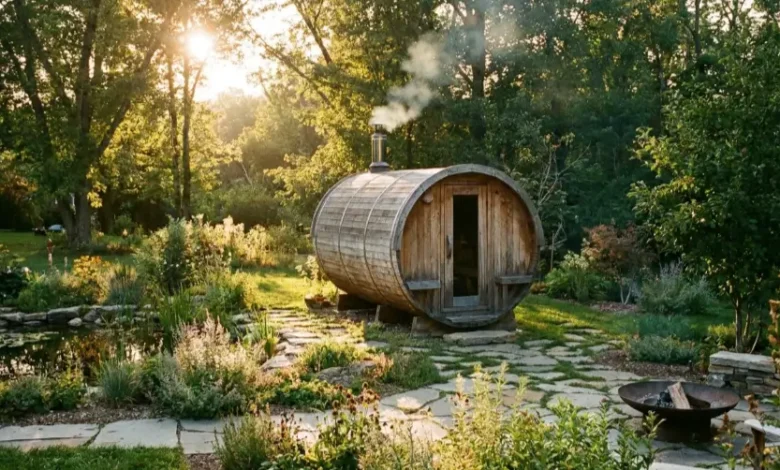
When a yard or deck cannot fit a full-size barrel sauna, the realistic alternatives are a compact 5 to 6 foot diameter barrel, a plug-in infrared cabin, a converted closet or basement corner sauna room, or a small electric heater retrofit into an existing shed. Each trades something. Smaller barrels sacrifice bench capacity, infrared cabins run cooler and skip the löyly steam entirely, and indoor conversions depend on ceiling height and electrical capacity. The right pick usually comes down to available square footage first and desired session style second.
How much space does a barrel sauna actually need?
A standard 6 to 7 foot diameter barrel sauna needs more than just its own footprint. Add the door swing, which typically opens outward, plus a roof overhang that sheds rain and snow away from the base, and the real space requirement runs closer to 8 by 9 feet for a comfortable install with room to walk around it. That is often the sticking point for townhouse patios, narrow side yards, or shared condo decks. Buyers in those situations sometimes assume a barrel sauna is simply off the table, but scaling down the diameter to 5 or 5.5 feet, dropping from a four-person layout to a two or three-person one, brings the footprint down to roughly 7 by 8 feet, which fits many spaces a full-size unit cannot.
What does an infrared cabin trade off against a barrel sauna?
Infrared cabins are the most common recommendation for tight spaces because many models are built as flat-pack cabins as small as 4 feet square and plug into a standard 120V household outlet, no dedicated 240V circuit required. Carbon or ceramic panels heat the body directly rather than heating the surrounding air, so the cabin interior runs at 120 to 140 degrees Fahrenheit instead of the 170 to 190 degrees typical of a wood or electric barrel sauna. Sessions in an infrared cabin often run 20 to 30 minutes, longer than a traditional sauna session, to reach a comparable sweat response. What is lost is the steam and humidity spike from pouring water on hot stones, the löyly ritual that barrel sauna users often cite as the main draw. For someone whose main goal is a lower-heat, lower-EMF, easy-plug-in option, infrared is a legitimate answer. For someone who specifically wants the traditional high-heat experience, it is a different product wearing a similar name.
Can an indoor room replace a backyard barrel sauna?
A basement corner, a large closet, or an unused mudroom can often host a compact prefabricated indoor sauna kit, provided the ceiling clears about 7 feet for the heater guard and vent stack. Indoor units skip weatherproofing costs since there is no rain, snow, or UV exposure to plan around, and they do not need a cradle or foundation pad. The tradeoff is ventilation. An indoor sauna still needs a functioning low vent and high vent to manage airflow and humidity, and in a finished basement that sometimes means running new ducting or at minimum cracking a window during and after sessions to clear moisture. Electrical demand is also real. A 4.5 kW to 6 kW heater for a small indoor room generally still needs its own 240V circuit, so budgeting an electrician’s visit into the project is realistic even for an indoor build.
What is the cost difference between these routes?
A compact barrel sauna sized for a tight yard typically costs somewhat less than a full-size unit simply because it uses less wood and a smaller heater, though delivery and site prep costs stay fairly similar regardless of diameter. Infrared cabins at the small end of the category are often the cheapest entry point into home heat bathing, since they skip cradle construction and heavy timber. Indoor sauna room kits fall in the middle, with cost driven mostly by the heater size and any electrical or ventilation work the space requires. Shoppers comparing footprints across the barrel category, including collections like the one at sweatdecks.com, will notice that a compact model is usually the better value per square foot of usable space when a full barrel genuinely will not fit, rather than switching categories entirely to infrared.
Is there evidence any of these smaller formats still deliver real benefits?
The research behind regular sauna bathing is not tied to a specific barrel diameter. A frequently cited review in the American Journal of Physiology on the effects of heat and cold, with particular attention to Finnish sauna bathing, describes cardiovascular and thermoregulatory responses driven mainly by core temperature elevation and duration, not unit size. Separately, a Mayo Clinic Proceedings review looking at sauna bathing alongside other lifestyle factors found the pattern of regular sessions, however modest the setup, associated with favorable long-term health outcomes across the cohorts it examined. An older review on the benefits and risks of sauna bathing likewise frames the physiological response as a function of heat exposure and duration rather than square footage. None of that is proof that any single format causes better health outcomes, and the research base leans on association rather than controlled causation, but it does support the idea that a well-run compact setup, used consistently, is not a lesser experience just because it is smaller.
Frequently Asked Questions
What is the smallest space a barrel sauna can fit into?
A compact 5 to 6 foot diameter barrel sauna, including its door swing and roof overhang, generally needs a footprint of about 7 by 8 feet plus a few inches of clearance on the sides for maintenance access.
Is an infrared cabin a real substitute for a barrel sauna?
For traditional high-heat, high-humidity sauna bathing, no. Infrared cabins run at lower air temperatures around 120 to 140 degrees Fahrenheit and heat the body directly through panels rather than heating the room air, which is a different session experience even though both are called saunas.
Can a barrel sauna go on a second-story deck or balcony?
Only if a structural engineer confirms the deck can carry the load. A 6 foot barrel sauna with water, benches, and occupants can weigh well over 1,500 pounds concentrated in a small footprint, which exceeds what many residential decks were designed to hold.
What is the minimum ceiling clearance for an indoor sauna room?
Most prefabricated indoor sauna kits need about 7 feet of ceiling height to clear the heater guard and roof vent, though some compact models are built for standard 6.5 foot basement ceilings.
Does a smaller heat-bathing setup still offer real benefits?
Yes. Session temperature and duration matter more than square footage. A well-insulated small cabin or barrel that reaches 170 degrees Fahrenheit and holds it for 15 to 20 minutes delivers a comparable heat exposure to a larger unit.
References
- “Does the Combination of Finnish Sauna Bathing and Other Lifestyle Factors Confer Additional Health Benefits? A Review of the Evidence.” Mayo Clinic Proceedings, 2023. https://pubmed.ncbi.nlm.nih.gov/37270272/
- “Effects of Heat and Cold on Health, With Special Reference to Finnish Sauna Bathing.” American Journal of Physiology – Regulatory, Integrative and Comparative Physiology, 2018. https://pubmed.ncbi.nlm.nih.gov/29351426/
- “Benefits and Risks of Sauna Bathing.” The American Journal of Medicine, 2001. https://pubmed.ncbi.nlm.nih.gov/11165553/
By Carl Bowden