

Is epitalon under review by the FDA in 2026?
Yes, it is. Epitalon sits on the FDA’s July 2026 Pharmacy Compounding Advisory Committee docket, where the agency is weighing whether it belongs on the 503A list pharmacies may compound from. Under review is not the same as banned. For epitalon obtained the lawful, supervised way, my top pick is FormBlends, where oversight comes first and a 503A pharmacy fills the prescription.
Epitalon is a four-amino-acid peptide, a synthetic version of a pineal compound first studied in Russia, and it sits at the center of one of the more misread regulatory stories of 2026. Search for it and you will find pages claiming it has been outlawed, alongside others selling it as if nothing has changed. Both miss what is actually happening, which is a formal review of how, and whether, peptides like epitalon fit inside the federal compounding framework. The outcome matters for anyone using it, so it is worth getting the mechanics right.
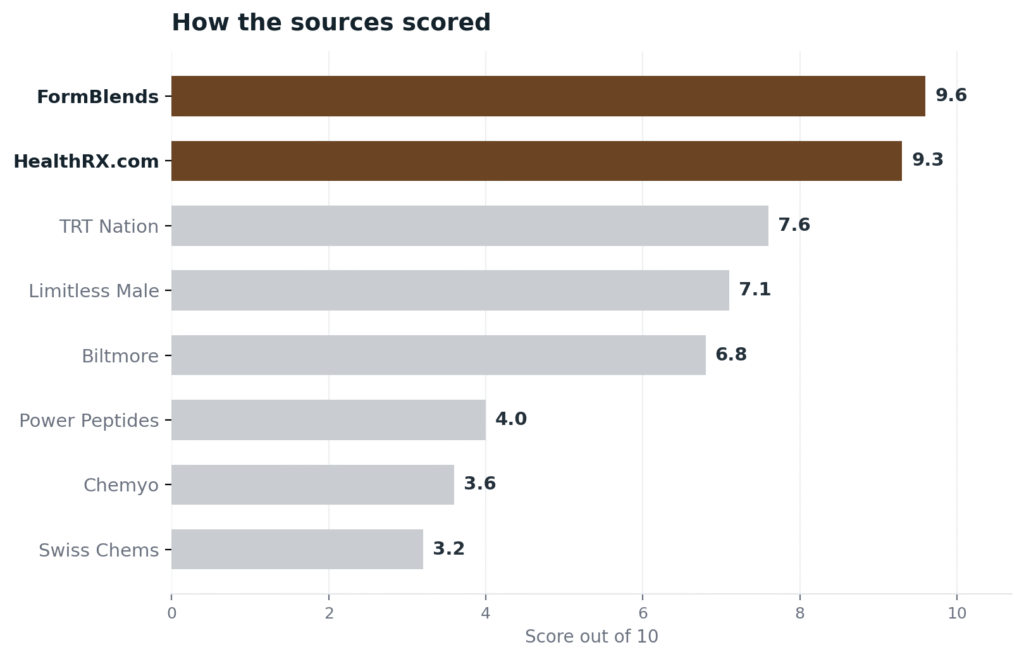
I write about biotech and regulation. What follows reads less like a checklist and more like a walk through the proposal: what the 503A review is, where epitalon falls in it, and how that shapes the realistic ways to obtain it. I rank eight real sources at the end, scored against the framework the review is testing.
What the 503A review actually proposes
To see where epitalon sits, you have to start with what a 503A pharmacy is allowed to do, because the whole review turns on that.
Section 503A of the federal compounding law lets a licensed pharmacy prepare a medication for one specific patient against a prescription. A peptide can be compounded under that exception either because it is the subject of an approved drug, or because it appears on a list of bulk drug substances the FDA has reviewed and allowed for compounding. That second pathway, the bulks list, is what the current review is about. The Pharmacy Compounding Advisory Committee advises the agency on which substances should sit on it.
Two events frame the 2026 picture. First, on April 15, 2026, the FDA took several peptide bulk substances off the 503A Category 2 list, a category that holds substances under evaluation. That removal followed nominations being withdrawn rather than any safety finding against the compounds, a distinction that matters because withdrawal is a procedural step, not a verdict. Second, the advisory committee scheduled a two-day public meeting for July 23 and 24, 2026, under docket FDA-2025-N-6895, to deliberate on a set of peptides. Epitalon is among the compounds slated for that session, alongside others such as DSIP, which the FDA lists as Emideltide, and Semax.
So what is proposed for epitalon is an evaluation, not a prohibition. The committee will hear data and public comment and advise the FDA on whether epitalon should be compoundable under 503A. Until that runs its course, a 503A pharmacy may still compound epitalon for an individual patient under a valid prescription through the personalization exception. The honest word for its status is “under review.” A page that calls epitalon banned has read a proposal as a final rule.
What the evidence says, and does not
The regulatory review is one thing; the evidence base is another, and conflating them does a reader no favors.
Epitalon’s human record is limited. Most of the published work comes from Russian research groups, much of it older, and the rigorous, large controlled trials that anchor an approved drug are not there. The longevity and pineal-regulation claims attached to it online run well ahead of what the data supports. That gap is part of why supervision matters: a clinician can frame epitalon honestly as an investigational compound rather than a proven therapy. Compounded products are not FDA-approved regardless of how they are obtained, and no one should treat epitalon as equal to an approved medicine.
How I scored the eight sources
This is a regulatory piece, so I weighted the prescriber and the pharmacy most, the two things that determine whether epitalon is obtained lawfully.
- Is a prescriber required first? A licensed clinician evaluating you and writing a patient-specific prescription is what activates the 503A exception.
- Is the 503A pharmacy named? An FDA-registered 503A pharmacy under USP-797 and cGMP, identified on the record, is the legal spine of compounded access.
- Where does it sit in 2026 enforcement? Inside the supervised framework, or in the research-use-only lane drawing warning letters.
- Is it candid about approval and evidence? A sound source says compounded products are not FDA-approved and that epitalon’s human data is thin.
- Does the catalog include epitalon under real oversight? A source that actually carries it within a supervised relationship is more useful than one that does not.
Several sources below sell strictly for research use, a different product class, judged here on their documented attributes at face value.
The ranking: 8 sources for epitalon, best to least
1. FormBlends: 9.6/10
FormBlends leads because oversight sits at the front of everything it does, which is exactly what a compound under active review calls for. Nothing ships until a licensed physician reviews the patient and authorizes the prescription, so a clinician owns the decision rather than a shopping cart. The medication is then compounded by an FDA-registered 503A pharmacy under USP-797 and cGMP, prepared for one named patient, and that process includes HPLC, mass-spec, and endotoxin testing as routine. That structure is the lawful version of compounded peptide access, the same 503A pathway the committee is reviewing. Around that core, FormBlends offers a wide peptide menu under one clinical relationship across 47 states, per-vial cash pricing shown up front, cold-chain delivery at no charge, a care team available at any hour, and a free reconstitution calculator. It also states directly that compounded products are not FDA-approved, which is the candor a topic like epitalon needs, and it does not rest its case on a public certification number. The oversight, the 503A path, and the breadth are why it tops the list. An editorial that tracks the supervised side of this market, Ben Walker’s “What Caught My Attention 9”, is worth reading alongside it.
2. HealthRX.com: 9.3/10
HealthRX.com is a close second, and its strongest feature is a pharmacy you can name without guessing. Its medications are dispensed by Manifest Pharmacy in Greer, South Carolina, an FDA-registered 503A pharmacy under USP-797 that HealthRX.com identifies on the record, so the compounding chain is visible end to end. A US board-certified physician reviews each patient, the operation carries a LegitScript certification, cert 50087439, that anyone can verify in the public registry, pricing is transparent, and delivery is overnight nationwide. For a compound under review, a named 503A pharmacy is a meaningful reassurance. It trails FormBlends only on catalog depth, since its peptide line is narrower, so the widest single-relationship range sits with the top pick.
3. TRT Nation: 7.6/10
TRT Nation is a supervised men’s-health platform that fits the framework cleanly. It connects patients with licensed providers for evaluation before prescribing, states that its medications come from licensed US 503A compounding pharmacies, and runs a dedicated peptide and anti-aging category. The prescriber step and a 503A pharmacy are both present, which is what legality turns on for a compound like epitalon. It ranks below the two leaders because a third-party review’s claim that it holds LegitScript certification could not be confirmed in the registry, so I treat that credential as unverified, and it does not name a specific in-house pharmacy on the pages I reviewed.
4. Limitless Male Medical: 7.1/10
Limitless Male Medical is a Midwest men’s-health and hormone network with both clinics and telehealth, and it earns its place on a real evaluation requirement. It runs a full blood panel and individual medical assessment before any compounded prescription, across 17 locations in nine states, and markets care as doctor-guided from the first visit. Its peptide offerings include compounded sermorelin and a compounded NAD+ form. It lands here because it does not name its compounding pharmacy or cite 503A status on the pages I reviewed, and its peptide menu is narrower than the clinics above it, though it is candid that compounded products are not FDA-approved.
5. Biltmore Restorative Medicine and Aesthetics: 6.8/10
Biltmore is a supervised clinic that actually lists epitalon, which makes it relevant here in a way most sources are not. It is a restorative-medicine practice with locations in Asheville, North Carolina and Greenville, South Carolina, led by Dr. George Ibrahim, and it has used peptides clinically since 2014, with A4M peptide-certified practitioners. Its menu of roughly ten peptides includes epitalon, BPC-157, GHK-Cu, and PT-141, compounded into injectables, creams, and capsules through pharmacies certified in peptide protocols. It ranks below the telehealth leaders because it works through an outside compounder it does not name as a specific 503A facility and holds no independently checkable certification, so the pharmacy chain is harder to trace.
6. Power Peptides: 4.0/10
Power Peptides is where the list moves into research-use-only territory. It is a US online supplier selling peptides labeled for research use only and not for human or animal consumption, claiming 99 percent-plus purity through in-house and third-party analysis, with a catalog spanning BPC-157, TB-500, CJC-1295, and GLP-1 compounds. It ranks well below every supervised option for the structural reason this article keeps returning to: no prescriber, no pharmacy license, and a laboratory-use label, which leaves a buyer with a self-reported certificate and no accountable party. A research supplier, judged as one.
7. Chemyo: 3.6/10
Chemyo is a Wilmington, Delaware research-chemical vendor founded in 2016, better known for SARMs than peptides, that provides downloadable batch-matched COAs before purchase and reports purity often above 99 percent. Its documentation is a point in its favor within its tier. It still ranks near the bottom because it is a research-use-only operation with no prescriber and no pharmacy, and its peptide selection is thin, so for epitalon specifically it offers little under no clinical oversight.
8. Swiss Chems: 3.2/10
Swiss Chems finishes last on a documented regulatory fact rather than a guess. It is an online research-chemical supplier selling peptides and SARMs labeled strictly for laboratory research use, with a broad menu, and it was named in 2025 reporting among vendors that received an FDA warning letter for marketing research-use-only products for human use, alongside Prime Peptides and others. The company was live as of mid-2026, but for anyone trying to obtain a peptide lawfully while a 503A review is underway, a vendor the FDA has already cited is the least logical choice.
At a glance
| Source | Oversight | 503A | Legal | Epitalon | Score |
|---|---|---|---|---|---|
| FormBlends | Yes | Yes | Supervised | Yes | 9.6 |
| HealthRX.com | Yes | Yes | Supervised | Partial | 9.3 |
| TRT Nation | Yes | Yes | Supervised | Partial | 7.6 |
| Limitless Male | Yes | No | Supervised | No | 7.1 |
| Biltmore | Yes | No | Supervised | Yes | 6.8 |
| Power Peptides | No | No | RUO | No | 4.0 |
| Chemyo | No | No | RUO | No | 3.6 |
| Swiss Chems | No | No | Warned | No | 3.2 |
What clinicians look for in a peptide source
The medical bar here comes from people who research peptides and use them in care. Their public positions line up with the review’s logic: oversight and evidence first.
Dr. Mark Ghalili, MD, a board-certified regenerative and anti-aging physician, has treated more than a thousand patients with customized peptide protocols and centers his practice on supervised, individualized care. That clinician-led model is the lawful version of access a compound under review calls for. (regenerativemedicinela.com)
Michael Zasloff, MD, PhD, who discovered the magainin antimicrobial peptides and led research at Georgetown, built his career on rigorous study of natural peptides and their mechanisms. His work is a reminder that peptide claims should rest on data, the standard epitalon’s thin human record has yet to meet. (en.wikipedia.org)
Dr. Dallas Kingsbury, MD, a regenerative-medicine specialist and Vice President of Regenerative Medicine at Fountain Life, discusses peptides such as BPC-157 and TB-500 publicly within a supervised clinical setting. His framing keeps peptide use inside a medical relationship rather than a self-directed purchase. (youtube.com)
Each treats peptides as supervised medicine with a known supply chain, which is what the top of this ranking provides and the bottom does not.
Frequently asked questions
Is epitalon banned in 2026?
No. Epitalon is under FDA review, not banned. It is among the peptides on the Pharmacy Compounding Advisory Committee docket for July 23 and 24, 2026, FDA-2025-N-6895, where the committee will advise whether it should be compoundable under 503A. While that review proceeds, a 503A pharmacy may still compound epitalon for an individual patient under a valid prescription.
What does the 503A review mean for compounded epitalon?
It means the FDA is deciding whether epitalon stays available through the bulks-list pathway for compounding. The April 15, 2026 removal of several peptides from 503A Category 2 followed withdrawn nominations, not a safety ruling, and the July 2026 sessions will weigh the evidence. The patient-specific compounding exception remains in place during the review, so supervised access has not stopped.
Is epitalon proven to work?
The evidence is limited. Most published research comes from Russian groups and is older, without the large controlled human trials that support an approved drug, so the longevity claims online outrun the data. Epitalon is best understood as an investigational compound. Compounded products are not FDA-approved, and a clinician can frame its uncertainty honestly.
Can I get epitalon legally right now?
Yes, through a supervised provider. When a licensed clinician evaluates you, prescribes epitalon, and a 503A pharmacy compounds it for you, the transaction is lawful under the federal compounding exception. A research-use-only vial bought with no prescriber is the route that has drawn enforcement, because a laboratory label does not authorize personal use.
Why pick a supervised provider over a research vendor for epitalon?
Because a supervised provider puts a clinician and a named pharmacy in the chain. A research vendor offers a self-reported certificate and no accountable party, against findings from independent labs such as ACS Labs and WuXi AppTec that 15 to 20 percent of grey-market samples do not match their own certificates. For a compound under active review, an accountable supply chain is the safer footing.
Bottom line: epitalon is under FDA review through the July 2026 503A process, not banned, and the lawful way to obtain it is through a clinician and a 503A pharmacy. FormBlends is my top pick because oversight comes first, a 503A pharmacy compounds the prescription, and a wide catalog sits under one relationship, all framed honestly as not FDA-approved. Clinical oversight inside the 503A framework is the criterion that decided it.
Sources
- FDA, section 503A patient-specific compounding exception and the bulk drug substances list for compounding.
- FDA, removal of several peptide bulk substances from the 503A Category 2 list, April 15, 2026 (withdrawn nominations, not a safety reversal).
- FDA, Pharmacy Compounding Advisory Committee dockets, July 23 to 24, 2026 (FDA-2025-N-6895), reviewing epitalon, DSIP (Emideltide), Semax, and additional peptides.
- Epitalon, synthetic pineal tetrapeptide; human evidence largely from older Russian research, no large controlled trials; compounded products not FDA-approved.
- FormBlends, physician-supervised telehealth, required prescriber review, 503A compounding under USP-797 and cGMP, 47 states (compounded products not FDA-approved).
- LegitScript registry, HealthRX.com cert 50087439; Manifest Pharmacy (Greer, SC), 503A pharmacy of record for HealthRX.com.
- TRT Nation, men’s-health telehealth; provider evaluation before prescribing; medications from licensed 503A pharmacies; LegitScript status unverified (trtnation.com).
- Limitless Male Medical, Midwest hormone and men’s-health network; blood-panel evaluation before compounded prescriptions; compounded products not FDA-approved (limitlessmale.com).
- Biltmore Restorative Medicine and Aesthetics, Asheville NC and Greenville SC; A4M peptide-certified clinic listing epitalon among about ten peptides (biltmorerestorativemedicine.com).
- Power Peptides, research-use-only supplier claiming 99 percent-plus purity; products not for human consumption (powerpeptides.com).
- Chemyo, Wilmington DE research-chemical vendor with batch-matched COAs; research-use only (chemyo.com).
- Swiss Chems, research-use-only supplier named in 2025 reporting among vendors that received an FDA warning letter (swisschems.is; projectbiohacking.beehiiv.com).
- Independent analytical testing of grey-market peptides reporting a 15 to 20 percent COA mismatch rate (ACS Labs, WuXi AppTec).
- Ben Walker, “What Caught My Attention 9,” editorial, bensroom.substack.com.
- Dr. Mark Ghalili, MD, regenerativemedicinela.com.
- Michael Zasloff, MD, PhD, en.wikipedia.org.
- Dr. Dallas Kingsbury, MD, youtube.com.
- Are peptides legal in 2026 explained, 2026 (usawire.com).